
For 35 years, three remarkable staff members in the School of Arts and Sciences have quietly shaped campus life, the student experience, and Dartmouth’s future.
While their roles span undergraduate housing, advancement and financial aid, and faculty leadership, the stories of Anita Dole, Cornelia Purcell ’80a, Guarini ’96, and Janet Terp converge around care, continuity, and a shared commitment to making Dartmouth better for the people who live, learn, and teach here.
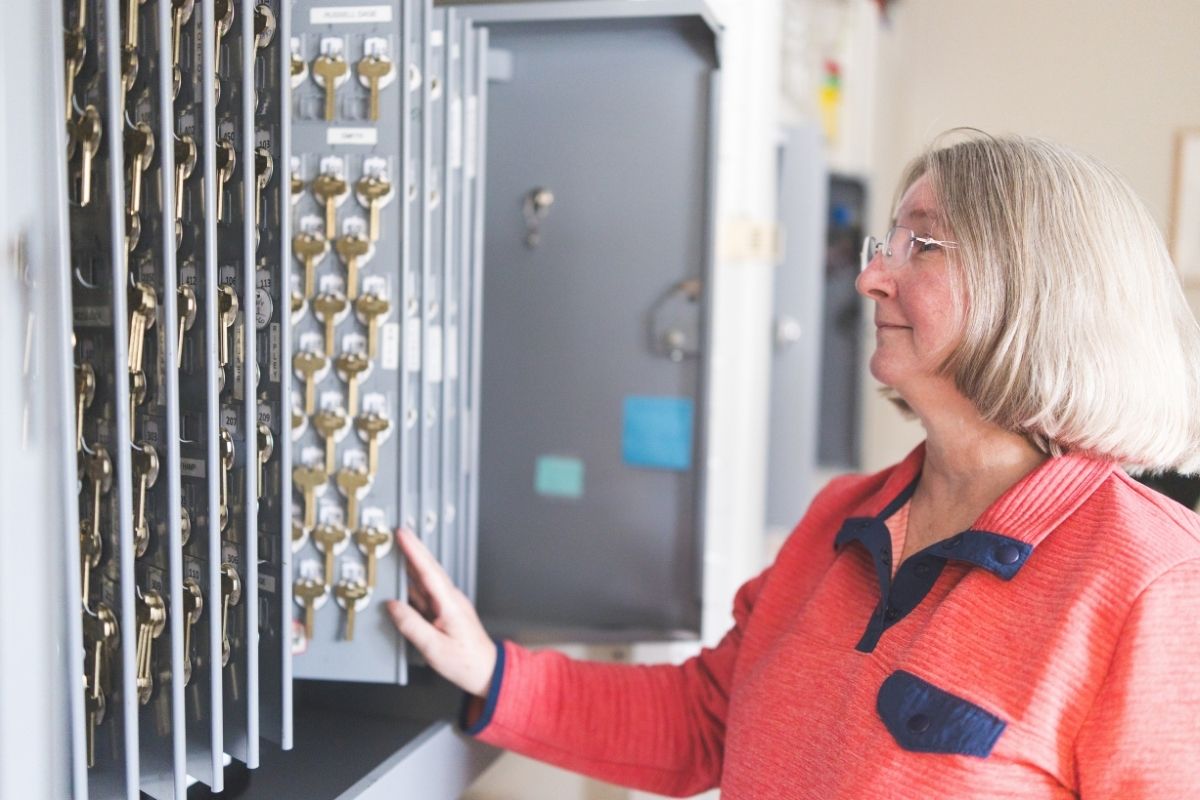
Anita Dole (Photo by Katie Lenhart)
Supporting the student experience
Anita Dole’s connection to Dartmouth began close to home. Having grown up in the Upper Valley, the college was a familiar presence long before she joined Buildings and Grounds, now known as Facilities Operations and Management, in 1990. One of Dole’s earliest projects involved creating an organized inventory of building plans across campus, bringing order to an analog system that would later become fully digital. That experience—methodical, practical, and foundational—set the tone for a career built around careful stewardship and steady problem solving.
Dole’s path has taken her through several corners of campus. She has also worked for the Child Care Project, a Dartmouth-housed resource that referred parents to childcare and provided training for childcare providers, Campus Billing and DartCard Services, and Undergraduate Housing within the Office of Residential Life, where she has worked since 2018. Across these myriad roles, her focus has remained the same—making systems clearer and smoothing the path for others.
In her current role as housing services manager, Dole manages the complex logistics of interim housing assignments, coordinating placements for students who remain on campus between academic terms, whether for athletics, sponsored programs, or personal need.
She also oversees the collection, tracking, and redistribution of keys for dorms, Living Learning Communities, Greek houses, and apartments—a responsibility that requires accuracy, persistence, and a talent for solving what she describes as a puzzle. Alongside this work, she hires and supervises student staff, mentoring them as they manage office communications, assist with housing systems, and support special projects.
“Anita is fantastically detailed and thinks through all the possibilities of any given decision or project, which helps ensure success,” says Rachael Class-Giguere, director of undergraduate housing in the Office of Residential Life. “She combines her strong administrative and organizational skills with kindness and loyalty, and it’s fabulous to see the many relationships she’s maintained with people throughout the campus over her time at Dartmouth.”
For Dole, it’s the human side of the job that proves most rewarding. She cherishes the students she works alongside, the ones who wander into the office with questions, and the relationships she’s built with colleagues across campus. While Dartmouth has changed significantly during her tenure, she notes that the quality of the students and staff—their curiosity, commitment, and desire to make a difference—has endured.
So too have Dole’s commitment and care.
“While the world may be spinning with the next request already in the queue, never once have I seen Anita lower her care and focus on the issue at hand,” says Joshua Monette, associate director of student affairs information systems in the Division of Undergraduate Student Affairs. “Anita is someone who I seek to work with each day. She is kind and silly with a touch of mischief that makes problems a joy to tackle together. I feel lucky to both support her and learn from her as a colleague and friend.”
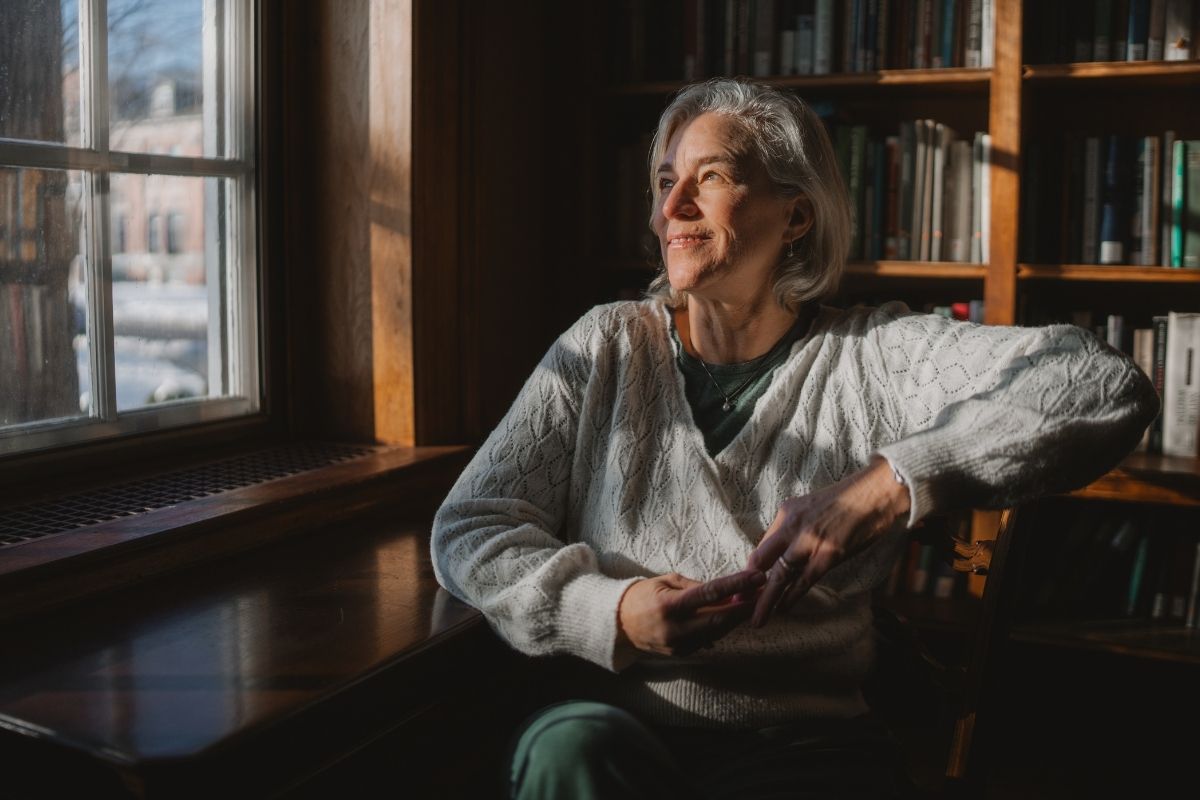
Cornelia Purcell (Photo by Robert Gill)
Expanding access and opportunity
Cornelia Purcell’s 35-year career in Advancement at Dartmouth began with a bit of serendipity.
New to Hanover in 1990, she had breakfast with an alumna of her alma mater who worked as a fundraising consultant and learned all about the world of development and fundraising. A couple weeks later, a position at Dartmouth opened in development research and Purcell’s long and impactful career began.
From there, Purcell moved into major giving, designing systems and writing proposals for colleagues traveling to visit alumni before she herself went out on the road to connect with potential donors. Since then, she has worked for the Dartmouth College Fund, which raises money for financial aid, participated in three institutional fundraising campaigns, and served as director of annual giving for Tuck School of Business.
“Cornelia is a skilled coach and leader who continues to innovate and push the status quo,” says Kathryn Munro, associate vice president of arts and sciences development. “The great strides we have made in fundraising for expanding student access and affordability over the years, including more than $500 million raised in the Call to Lead campaign, are directly linked to Cornelia’s vision and dedication to this important work.”
G. Dino Koff, assistant vice president and executive director of the Office of Financial Aid, agrees. “It was Cornelia’s vision, attention to detail and an incredible attitude that allowed Dartmouth to realize the huge scholarship goal of the Call to Lead campaign,” Koff says. “She understands scholarships and how they allow Dartmouth to matriculate the best and the brightest students from around the globe. Dartmouth would not have taken the leap into the 21st century of aid without Cornelia.”
During the pandemic, Purcell also helped launch the Presidential Commission on Financial Aid, which included then-President Philip J. Hanlon, Provost Joseph Helble, board chair Laurel Richie ’81, and 26 alumni from around the world. The group met on Zoom for two years to change policies around financial aid loans and ensure Dartmouth could become fully need-blind for international and domestic students.
Today, Purcell works on a nimble Arts and Sciences advancement team, which supports opportunities and initiatives related to financial aid, undergraduate student affairs, off-campus programs, first-generation initiatives, and more. Her approach to fundraising has always been holistic, and in her current role, she continues to find new ways to help Dartmouth expand and strengthen student opportunities.
“I think about the equity of experience for people as they come here to Dartmouth,” says Purcell, a first-generation college graduate herself. “Making sure that people are able to and feel comfortable taking advantage of all the opportunities that are here without being burdened by financial constraints is so important.”
Purcell draws her energy from the people she works with and their stories—curious, driven colleagues and alumni who care deeply about the institution—and from the constant learning that advancement work demands.
“Cornelia is fearless, bold, and one of the smartest people I have ever worked with,” says Sandra Swain-Bromwell ’58a, managing director of the Dartmouth College Fund. “She is a force—someone who embraces every challenge with confidence, creativity, and her trademark can-do spirit. Her problem-solving skills, leadership, and wonderful sense of humor have served her colleagues, Dartmouth, and the broader community incredibly well.”

Janet Terp (Photo by Robert Gill)
Bringing faculty vision to life
Before arriving at Dartmouth, Janet Terp was a track coach, adept at balancing the countless moving parts of organizing and running a meet. She brought that coach’s mindset with her when she joined Dartmouth’s Advancement team in 1990, supporting institutional and campaign events. The role gave her an unusually broad vantage point—seeing how fundraising, governance, institutional events, and daily operations converged in service of Dartmouth’s mission.
From that bird’s-eye view, Terp moved into student affairs. Over the course of 10 years, she took on increasing responsibilities where she supported deans, liaised with the Board of Trustees, coordinated leadership searches, and played instrumental roles in major Student Life initiatives. In 2004, as word of Terp’s expertise spread, she was invited by then-Dean of the Faculty Carol Folt to join the dean’s office as chief of staff, where she has since helped anchor the day-to-day work of the Faculty of Arts and Sciences.
“When I asked Janet to be my chief of staff, we both knew we were crossing that cultural bridge across the Green, but [she] crossed it with grace and grit,” says Folt. “Janet fought hard for faculty and their big, transformational plans, and only a handful will ever know how essential [she was] to campaigns and development that supported all our dreams—[she] mastered that world too.”
Much of Terp’s work happens behind the scenes. She brings the right people together, and she takes pride in her team’s ability to manage complex and interdisciplinary projects while bridging gaps between ideas and execution.
“Janet works both across departments and divisions within Arts and Sciences and across the college to address challenges, solve problems, and ensure that the core mission of the Arts and Sciences remains front and center,” says Elizabeth F. Smith, Paul M. Dauten Jr. Professor of Biological Sciences, who worked closely with Terp during Smith’s tenure as dean of faculty. “I suspect Janet has played some role in virtually every fundraising initiative within the Faculty of Arts and Sciences during her tenure, often serving as a key liaison in translating faculty aspirations into successful proposals.”
Terp has spearheaded several key initiatives, including partnering with faculty to establish the International Relations Postdoctoral Fellows Program, an effort that secured multiple endowments. She also co-chaired a campus-wide committee to strengthen support for students with disabilities and oversaw the creation of a tool to assess and promote efforts to build a more inclusive, diverse, and equitable academic community.
A master collaborator and self-described generalist, Terp draws on her experience across athletics, student affairs, advancement, finance, and academics to translate vision into action. The recently launched Literary Arts Bridge exemplifies this approach: Terp served as project manager, partnering with creative writing faculty to transform their vision into a dynamic new space for creative writers across campus. She coordinated everything from budget development and renovations to staffing plans and fundraising proposals.
Terp finds the greatest reward in moments like the opening of the Literary Arts Bridge, when teams take pride in what they’ve accomplished and gather around what they’ve built together. When Terp reflects on her career, she returns to relationships. The work, she says, is not transactional but relational. Or, as she puts it: “It’s the ‘we’—not the ‘me’.”
Faculty point to the Literary Arts Bridge as just one of many projects where Terp played an integral role.
“She has helped us at the Political Economy Project navigate the sensitive art of working with donors, raising funding, and putting it all together to work for Dartmouth students and faculty,” says Douglas Irwin, John French Professor in Economics. “I admire her creative and constructive approach to everything we've collaborated on, as well as her sharp tennis game.”
“Throughout the years, I’ve known Janet as a trusted friend, a wise, no-nonsense, and honest advisor, and someone who took great pride in a job well done,” says N. Bruce Duthu, chair of the Department of Native American and Indigenous Studies, who worked with Terp in multiple offices throughout her tenure.
“Janet is one of those rare individuals who doesn’t begin by asking whether your project is viable—instead, she trusts that you, as a scholar, know its worth and asks rather how to help make it happen,” says Trica Keaton, Evans Family Distinguished Professor, who first met Terp while refining a funding strategy for a new institute at the recommendation of a colleague who referred to Terp as “brilliant strategist and genuinely supportive presence,” and another who described Terp as “one of Dartmouth’s quiet pillars … who makes the university better every day.”
“Janet took the time to truly understand my work, asking smart, thoughtful, and probing questions,” Keaton continues. “Every time that I reached out, she not only responded promptly, but always did so with kindness, grace, and care … She is, without question, one of Dartmouth’s heroes.”