
When Legacy of Light by the award-winning Mexican American playwright Karen Zacarías opens in a Department of Theater production on Feb. 20 in the new Daryl Roth Studio Theater, it will signal both a homecoming and a new beginning for the department.
The play, which runs through Feb. 28, marks the theater department’s first production fully built and produced at Dartmouth after the reopening of the Hopkins Center for the Arts in October.
“After several years in which our ability to produce large-scale work was limited by the pandemic and the Hop renovation, this production marks an important moment for the department,” says Associate Professor of Theater Analola Santana, chair of the theater department. “To have a bespoke theater in the Hopkins Center intended for experimentation just opens up possibilities for the department in terms of what we choose to produce, and how we produce it.”
Legacy of Light collapses time and space, as the action moves between 17th-century France and 21st-century America. Zacarías deftly and wittily explores issues of gender, patriarchy, maternal and romantic longing, and the power of big ideas and even larger physical forces.
The two female protagonists are scientists driven by their pursuit of knowledge: the historic figure Emilie du Châtelet, a mathematician and physicist who was also involved with the philosopher Voltaire; and Olivia, a modern-day astrophysicist, who believes she has discovered a new planet and thinks about the implications of such a discovery not only for her career but also the scientific community. At the same time, Olivia also longs to have a baby.
It is “a really beautiful story, not only about motherhood but also about what it means to be a woman pursuing a career and trying to balance that with a personal life,” says Edith Stevenson ’27, a double major in English and film and media studies who serves as the production’s dramaturg. To assist the actors in bringing life to the history, science, and mores of 17th-century France, she compiled her in-depth research into a packet that the actors could draw on.
First produced in 2009 at the Arena Stage in Washington, D.C., where Zacarías is a playwright in residence, Legacy of Light is notable for its “sense of comedy and timing and the nature of the questions it asks,” says Sarah Elizabeth Wansley, associate artistic director at Northern Stage in White River Junction, Vermont, and director of this production.
In 2010, Legacy of Light was awarded a special citation for best new play by the Harold and Mimi Steinberg/American Theatre Critics Association.

Dominique Quiñonez ’28 as Millie addresses Tanaz Muhamed ’26 as Olivia.
With its sword fights, physical comedy, romantic scenes, intellectual debates, period costumes, and expansive sets and lighting all designed and made by students and theater professionals, the play is well-suited to show what the Department of Theater can do in a state-of-the-art space, Wansley says.
“To have that full power of the theater behind you,” Wansley says, is thrilling for the nine actors in the cast.
There are other reasons to celebrate Legacy of Light’s initiation of the Roth theater, Santana says, including the fact that Zacarías is a Latina playwright.
Although the play is not “specifically about the Latiné experience, there is still a sense of it, because Karen’s identity is her own, and that has to come through in the performance,” Santana says.
The play has further resonance for Dartmouth students. Because of its subject matter, Legacy of Light asks them to think about the connections between science, history, and identity. “What are those connections, and what is the value in those connections, and how does theater help explain them?” Santana says.
The nature and subject of the play brought about a collaboration across disciplines at Dartmouth, Santana says, including the Department of Theater, the Department of Latin American, Latino, and Caribbean Studies, and the Department of Physics and Astronomy.
During rehearsal, Jonathan Cohn, a Guarini postdoctoral fellow in physics and astronomy, talked to the actors about Châtelet’s role in scientific history.
Perhaps best known for her work in translating and commenting on Isaac Newton’s Principia, Châtelet is only recently getting her due as a thinker and physicist, as historians of science reexamine the assumption that only "great men" contributed to our knowledge of the universe, Cohn says.
Châtelet “really advanced our knowledge and understanding of this concept of energy,” Cohn said, as she posited “this idea that energy cannot really be created or destroyed, it’s just transformed into different things, which is addressed in the play.”
Dartmouth's theater department is notable, both Santana and Wansley say, because it opens up the audition process to all students: you need not be a theater major to audition or to get a role in a production. Wansley says that auditions for Legacy of Light had the biggest turnout since the Hopkins Center closed in 2022. Rehearsals began in early January.
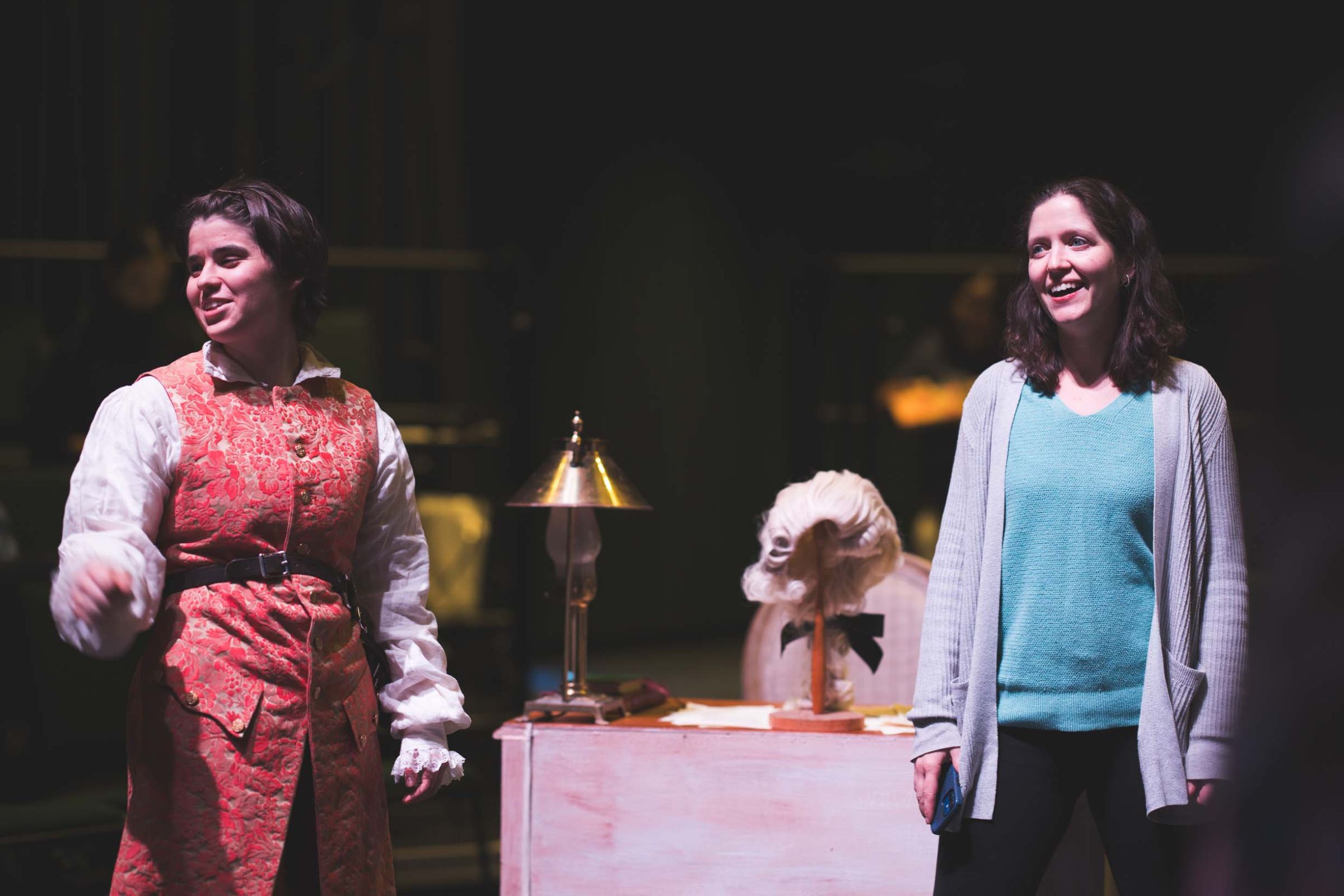
Grace Casale ’26, who plays Voltaire, rehearses with director Sarah Wansley.
As part of the rehearsal process, Zacarías participated in a Zoom call with the cast. “It was an incredible opportunity to ask her dramaturgical questions and to get additional character insight; and for her, to see young people really wrestling with her ideas,” Wansley says.
Theater major Tristyn Girouard ’27, who plays Emilie du Châtelet, finds particular meaning in her character’s belief that "everything changes but nothing is lost. Energy never disappears and the same energy that is around today was also around in the 17th century.”
Although Tanaz Muhamed ’26, who plays Olivia, is majoring in engineering sciences with a concentration in biomedical engineering, she has been doing theater “for as long as I can remember.” It is one of her passions, she says, although she does not plan to pursue it as a career.
Muhamed says she loves being back in the Hopkins Center and that to be able to rehearse in the Mindy Kaling Theater Lab, named for the film and TV writer and actor, is a privilege. Like Kaling, Muhamed is Indian American and the daughter of immigrants.
With the reopening of the Hopkins Center and the debut of the Roth theater, Dartmouth is highlighting the professionalism and expertise of the theater faculty and the production staff while also “introducing this art form to the next generation,” Wansley says.
“A theater department is never just there to train future professionals, but to serve the community in creating art,” Wansley says.
As a dramaturg, author, and historian of Latin American and Latinx theater, Santana has her own take: “I think students fall in love with coming to our department and doing productions. It really does give them a sense of purpose, and it gives them a sense of community. That’s why I always think that theater, no matter what you’re going to study, prepares you to engage with the world.”
The production will feature several discussions that explore Legacy of Light’s themes across disciplines. Professor Desirée Garcia, chair of the Department of Latin American, Latino, and Caribbean Studies, will lead a pre-show discussion on Feb. 28 at 6:30 p.m. at the Top of the Hop. Physics and astronomy professor Burçin Mutlu-Pakdil will give a talk on Feb. 21 after the 3 p.m. matinee. A post-show discussion with the cast and Wansley will take place on Feb. 27 in the Roth theater.