
A few years ago, Eloisa Roach ’28 was working as a research assistant for the Shawnee nation when she stumbled on something unexpected. While reading 19th-century records through the National Archives in Washington, D.C., Roach discovered documents showing that a few Shawnee women had obtained divorces from their husbands and taken land back as a form of alimony.
“Which is a kind of insane thing to be happening in the mid-19th century for any woman,” says Roach, who is from Iowa and is herself Shawnee.
A double major in history and Native American and Indigenous studies, Roach wanted to explore this apparent anomaly. But she knew she didn’t yet have enough background on 19th-century divorce law, and she needed more context on the status of women in an era when they couldn’t vote and had almost no legal autonomy.
Add to that the fact that “most people who were writing about women weren’t talking about Native women,” she says, “and most people who were talking about Native people weren't talking about Native women, either.” Roach felt she’d found a gap in the historical literature she could begin to fill.
As she dug further into the records, she realized that to talk about women was also to talk about children, and how land dispossession and changes in land titles profoundly affected both through the generations.
“I wanted to start understanding the broader context, and I knew I was not going to be able to get a fully realized final project, but I wanted to get it started and get moving,” Roach says.
So she applied to the Leslie Center for the Humanities to become a Student Research Fellow in Nineteenth-Century Studies, colloquially known as the C19 Student Fellowship, a program available to Dartmouth students in their sophomore year.
Created in 2021 by Colleen Boggs, professor of English and creative writing and associate dean of faculty for the arts and humanities, and Petra McGillen, associate professor of German studies, the program recruits from students enrolled in Global Humanities 1 and 2, the introductory sequence where many undergraduates first discover their interest in humanities research. Roach was unusual in arriving with a research project already underway; most fellows find their footing during the fellowship itself.
Students apply in the winter term of their first year; the fellowship runs 10 weeks (the length of a Dartmouth quarter), pays a $2,000 stipend, and asks for seven to 12 hours a week of research alongside a normal course load. Four students are chosen annually, McGillen says. The program is supported by the Leslie Center.
Each fellow is paired with a faculty mentor who guides original research or brings the student into supporting the mentor’s research. It’s a mutually beneficial arrangement, says Lynn Patyk, professor of East European, Eurasian, and Russian studies, who serves as co-director this year.
“We’re trying to get students excited about humanities research earlier than some of the other opportunities start,” McGillen says.
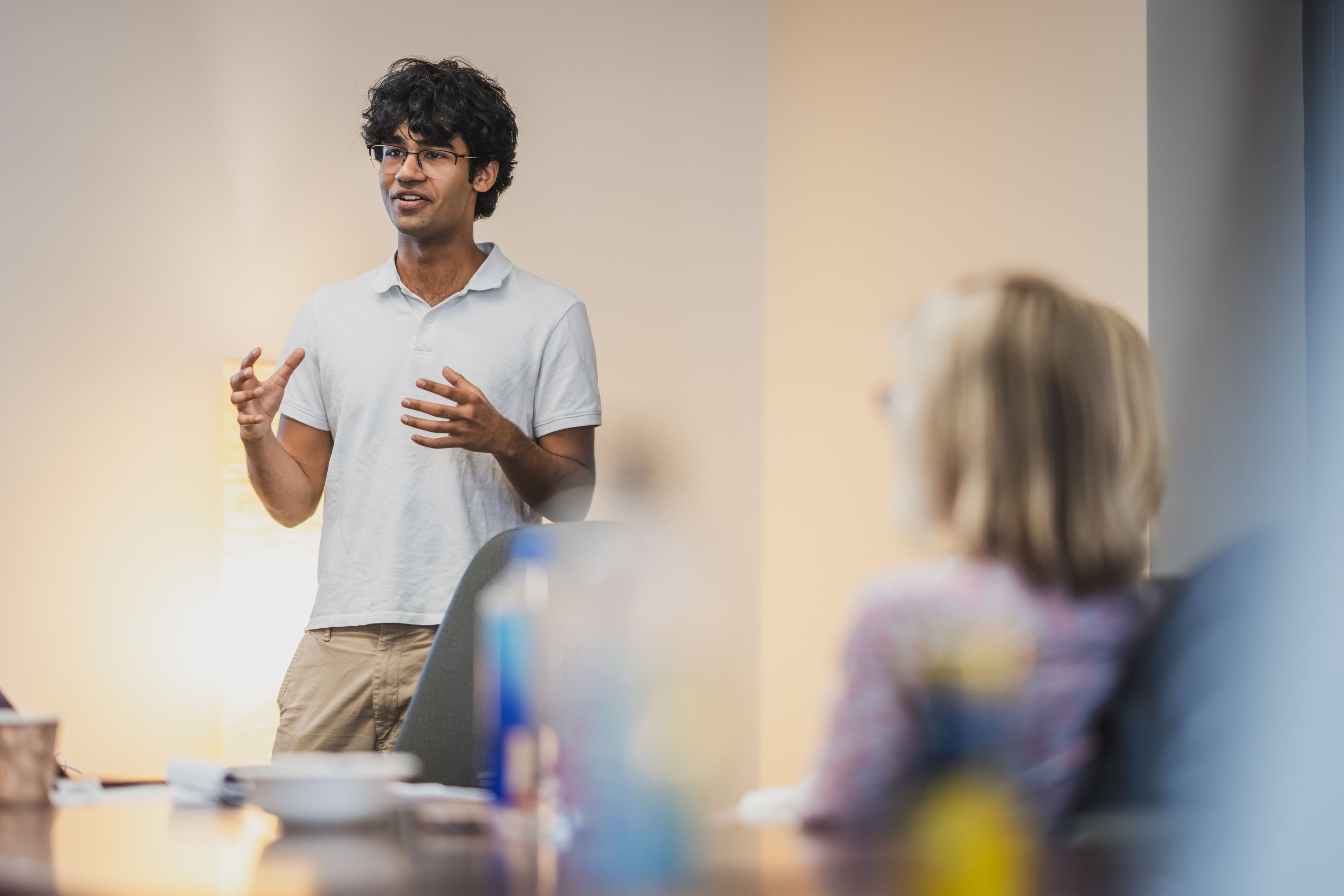
Rohan Taneja ’28 delivers his C19 presentation on May 8.
Most undergraduate research opportunities in the humanities at Dartmouth are geared toward juniors and seniors, McGillen notes, a gap that’s especially visible compared to the sciences, where students can get into a lab early. The C19 Student Fellowship was built to close that gap and give humanities students a structure for developing their research interests as sophomores.
Some applicants see the fellowship as a path toward academia. Others just want time with a subject they find compelling and wish to pursue in depth. Either way, if a student has “a good statement and a few strong ideas about what they would like to pursue, then the faculty member approaches this as a kind of mentorship in introducing students to doing research in the humanities,” Patyk says.
That research, she adds, is very much alive. “Students have to be aware that the humanities are not stagnating in any way, that they're always developing in the same way that the sciences are, and that they can be a part of that.”
Both McGillen and Patyk have worked closely with fellows on their own research. McGillen, who recently embarked on a new research project on 19th-century translations of popular English literature into German, worked with a student to investigate whether translation “factories” made cheap mass production possible. Patyk, who is researching conspiracy theories in 19th-century Russia, had a fellow compile a foundational bibliography, which required reading Russian to track down sources.
The fellows themselves also bring questions of their own.
History major Madeline Fisher ’27 spent part of her sophomore year working with Boggs on the 1876 Centennial Exposition in Philadelphia, an experience that brought her into the Rauner Special Collections Library.
The exposition came only 11 years after the end of the Civil War. It extolled American greatness and invoked the values of the Revolution, while omitting the history of Black Americans entirely. Native Americans were included, Fisher notes, but only as a foil to white settlers. Fisher is from St. Paul, Minnesota.
Learning to read 19th-century handwriting was hard. But it was worth it. “One of my favorite parts was sitting in the Rauner Library, which is such a beautiful building, and just looking over these old letters,” says Fisher, who now works at Rauner as a student assistant.
Neo Yee ’28, an art history major from New York City, wanted to examine the intersection of art and commerce but wasn’t sure where to start. Under the mentorship of art history professor Katie Hornstein, he narrowed his focus until he landed on an 1857 exhibition in Manchester, England, where the industrial city put on an enormous show featuring objects, textiles, and art from India, then a British colony.
The questions that followed were pointed: How did British organizers curate the Indian art? How did they identify, or misidentify, the objects? What did their choices say about empire?
What drew Yee in, he says, was “the independent nature” of the work and the immersion in research. Hornstein helped him refine his focus, find sources, and know when to stop adding material. The C19 Fellowship is a “great opportunity” for early undergraduate humanities research, he adds.
For some fellows, the program has already opened doors to more sustained research. Both Roach and Yee used their fellowship work as the basis for successful applications to the Mellon Mays Undergraduate Fellowship, a national program supporting students pursuing PhDs in the humanities. Roach also recently received a Udall Undergraduate Scholarship for Native American studies and public policy.
She plans to keep going. She wants to dig further into online 19th-century archives and travel to Kansas City, Kansas, where the Shawnee lived before the U.S. government removed them in 1869 to what is now Oklahoma, to comb through court records.
Her aim, given how often Indigenous women and children have been written out of the historical record, is to “find a way to tell these women’s and these children’s stories in a way that I think they would recognize.”
Boggs and McGillen built the fellowship to make these transformative research experiences possible. “When a research project takes off, you get into this dynamic with the material and with your own thought process,” McGillen says, “and that can be really powerful and truly eye-opening.”